
DAVID LEO RICE / JAKOB AS FATHER
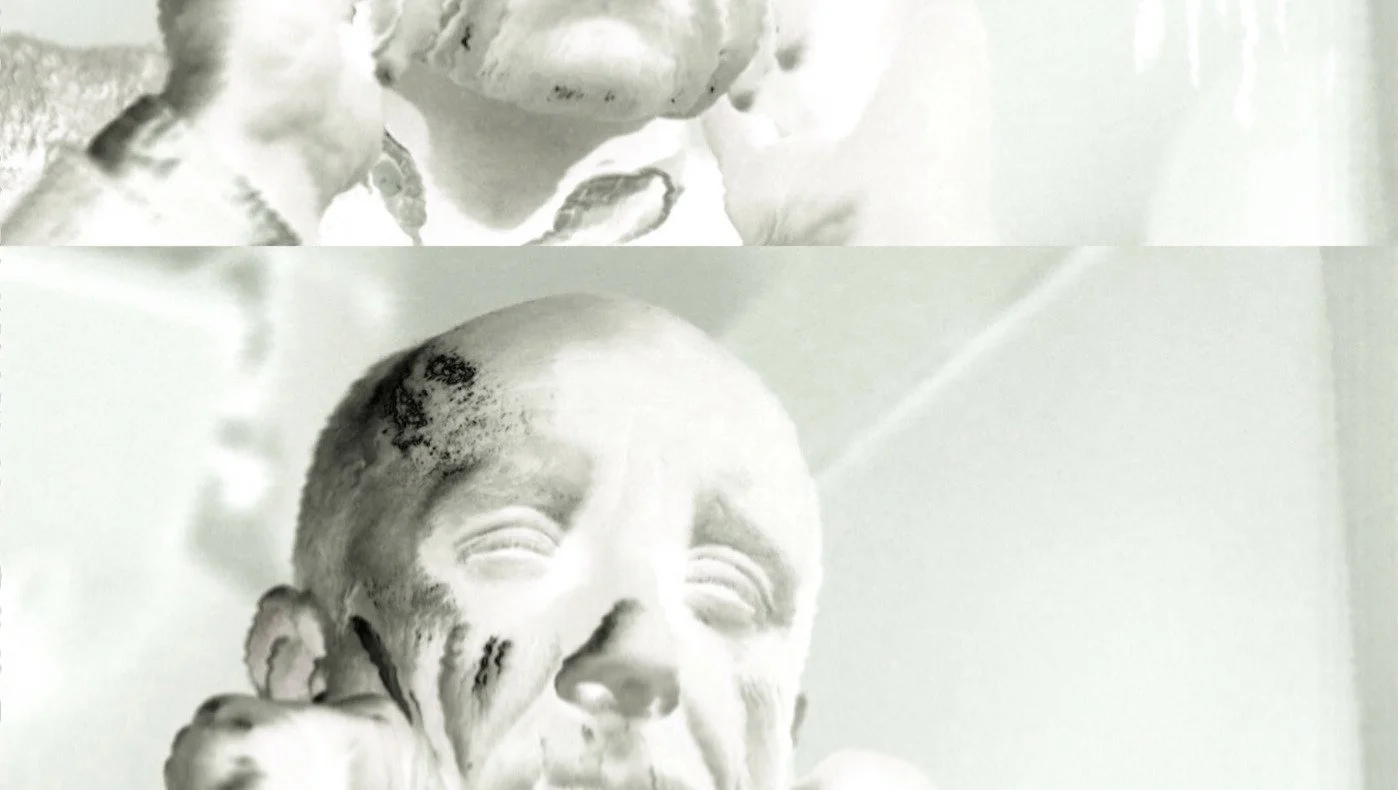
The name of Jakob would not stretch far enough to cover them both, and yet there was no other that either could use. Whether this doubled or halved the power the name carried with it was what remained to be seen.
—from The Biography
I.
Jakob the father paid at the till at the buffet in the town they’d arrived in after he’d gone as far as he could inside the giant. He’d glimpsed the New Jerusalem on the horizon through its eyes only to see it collapse, through his own eyes—boiling still with the need to prove himself in this world before abandoning it—into the dawn of a weekday he’d have to traverse as a man, stepping over the giant who’d collapsed into the burst bags of food-product he couldn’t help suspecting had also contained the sausage patties and home fries and sweet pull-apart rolls they’d all just finished eating at their booth in the old smoking section of the buffet hall where, he thought idly, he’d perhaps spent years’ worth of mornings just like this one, awaiting his chance to break through into the mature phase of his life.
He held the smoke-stained glass door for his wife and son, then led the way across the four-lane commercial strip through a break in the traffic and along the bike trail, past the encampments behind the supermarket, then off the trail and through a dogleg of the Tick-Singing Meadow, skirting an oxbow in the river that separated this town from its neighbor and rival on the other side. They followed the oxbow past the marina and onto the riverbank that led past a series of wooden garden shacks, each with its own square yard seeded with vegetables or flowers. The father itched his skin, peeling off the giant’s residue so as to allow as much of him as could be Jakob to return to the surface. As he reentered this name, or allowed it to well back up inside him, he kept his eyes on the grass and the river sliding along in the sunlight, listening to the fry of crickets and ticks.
But he couldn’t decide if he was seeing them for the first time or if they were what he saw every morning. If they were evidence that everything had changed, or that nothing had and perhaps never could. Just as his body moved forward by the alternation of his right and his left foot, his mind or whatever part of him was animate within that body seemed to move forward with this alternation of familiarity and estrangement, each mode replacing the other in a rhythm that itself alternated between a familiarity and estrangement of its own. Either I feel this way every morning, he thought, or I never have before. Either this is where I live and have always lived—except for a bleak, abortive spell in the city, bashing my head against what appeared to be a doorway and turned out to be a wall—or else I’m just now arriving, with my family in tow, after another long night in the open, blustery desert, stumbling out of a sandstorm that all the other families succumbed to.
Either this is how I grew up—he looked at the boy and couldn’t help thinking, How I am growing up—or it’s yet another waystation on a journey that lost all promise of a goal many generations ago, so that our ancestors would be appalled to see us still wandering, still hoping for an arrival they all learned to live without, creating in place of the New Jerusalem something akin to a culture out of the ravings that consumed their minds from the moment they learned to think until the moment they no longer could.
He stared at the grass and the water and the embankment on the far side, leading to a cabin on a mountaintop that he could picture just clearly enough to know it existed, but not clearly enough to know if it existed here or elsewhere, in a story he’d heard or in the one that would later be told about him. He picked up the pace when he felt his stomach twist and drop and a hard knot at the bottom begin to broil and melt. “Come on!” he shouted to his wife and son, breaking into a trot. It was his duty, he sensed, to make sure they were both safely inside the house before he took care of what would soon take care of itself. The memory of an accident in the woods, of pounding on the locked door of the garage with shit leaking through the ankles of his jeans and into his shoes until he was forced to peel off his socks and cover his feet with leaves, leaked into another memory of the same smell and the same wet heat trailing him down the stairs of the schoolhouse, away from the Trials in the gym and into the bathroom in the basement. The smell, mixed with fizzy pink hand soap and heavy white bleach, was so fresh it was as if it were happening right now, as if it were no memory at all, as if he’d already lost the race to make it back to his studio and would now pay the price in a world that could accommodate no history, a world that ran on a single track, a single present tense that was erased the moment it occurred, never to reappear except in the pages of the Biography, where all events would likewise seem to be occurring for the first time, describing the life of a Jakob who had lived nowhere except in those pages.
He broke into a run, abandoning his family, forgetting the river and the ticks and the mountain with the cabin on top. All of that flattened into wall paper while all that remained three-dimensional were his belly and his legs and, blessedly, the contours of his garage studio emerging, as if summoned, a gingerbread house glowing through the trees up ahead.
He leapt over the narrow brook that split off from the river between here and there and nearly flew across the weedy lawn behind the garage. After frantically undoing the combination lock that held the side door shut, he threw himself over paint cans and sheaves of butcher paper and Micron pens strewn uncapped on the concrete, nearly tearing the wood-slat bathroom door off its hinges as he dove onto the hot porcelain seat, flinging his jeans around his ankles just before he landed.
As he disgorged, rocking the bowl on its loose foundation, he panted and wiped sweat from his eyes and tried to draw out this interlude of pure sensation, already aware that phantasms were massing at the edge of his consciousness, patient but only up to a point. Take your time, they whispered, with their hands behind their backs and their heads inclined in a gesture of partial respect, but not too much of it. Time is precious to us too.
So he squeezed out all he could, thinking back on the popped food sacs in the buffet parking lot that had once constituted the giant, as if this process were the completion of that one, the final step in the daily process of emptying what remained in him from the other realm. The price he had to pay for returning here, with his chance to make something of himself not yet used up. When he’d done all he could, he wiped, pulled his jeans back on, and washed his hands with a creased sliver of Dove soap in the narrow tin sink. He dried his fingers on the last paper towel hanging from the roll and turned to leave the bathroom, only to turn again, so suddenly that the movement felt unnatural, like no part of him had planned or even authorized it.
He faced the toilet, looking back at himself sitting there. Though he knew this was impossible—even if things had turned strange, he still believed there were some rules; some cordon, he had to imagine, still stood between what could happen and what could not—and yet there he sat, a grown man, while, standing in the doorway, he now felt like a small boy, trembling under the weight of the TV/VCR console he’d stolen from the gym and dragged all the way down the back staircase of the elementary school he’d been forced to attend, if only as an example to another Jakob who’d been told by his mother that homeschooling was the only road to truth.
He stood there, having shown the man on the toilet video footage of the townspeople sacrificing their children to spiders in the high woods, and now it was time to beg that man for his freedom. To beg, or demand, if he could find the courage, to be set free. Free to return to the woods and complete the life’s work that had been strewn, unfinished, all across the path that extended into the unknown between where he stood now and where he would stand, if the pardon came through, at the very end of his life.
The freedom to finish his work and end the recursion for good. To put the Life of Jakob to rest.
“Release me into my work,” he begged, closing his eyes. “For God’s sake, let me go. Look,” he pointed to a rocking chair on the porch of the cabin onscreen, in which an old man sat in an open robe with an expectant look in his eyes, as if a visitor had just entered his field of vision. “That’s me. If you don’t let me go and become that man, things will unravel and, in no time neither of us will be here. You don’t want that, do you?”
When no answer emerged except a distant memory of having been pardoned already, years ago, in the schoolhouse that the garage had tentatively become, he leaned through the wall, peeling its foam from his forearms while he shook the toilet and bellowed, “Just let… me… work! Or kill me and do it yourself!”
He felt rage rising at the prospect that the pardon all those years ago had turned into another form of condemnation. A worse form, perhaps. An imprisonment in the garage, in the impossibility of completing his work, from which only murder at the hands of the ultimate Jakob could release him.
So he leaned forward, fell to his knees, and peered up in terror. “Kill me, Father,” he begged. “Crush the wind from my lungs and toss me on the heap with the others.”
Having crushed the coward who’d begged him to do so, Jakob at last felt released to begin his day. He tossed the emptied-out carapace onto a pile beneath the partial second floor in the back of the garage, where more bodies were stacked. I’ve done what I had to do to bridge the gap between breakfast and the good hours that now separate me from lunch, he thought. A gap that most artists, fine as their intellects and sophisticated as their training may be, never come anywhere close to bridging. Not for anything like a meaningful string of days. So few ever manage to get the walls of their studio to feel even as solid as these do now, however foamy they’re destined to remain.
He could feel anger welling back up at these nobodies, these throttled and armless sub-Jakobs lying inert and staring at the ceiling on damp mattresses in pasteboard dormitories, hanging around the mouth of the Lincoln Tunnel like scabbed-over canker sores. He let the anger subside before it sent him back to the bathroom, to beg for the freedom to begin yet again. If he went in there a second time without having achieved anything, he knew, whoever was waiting, if it turned out to be anyone, would have neither the authority nor the inclination to grant his request.
Glancing at the pile of bodies where he knew he’d narrowly avoided ending up, he turned toward the main workspace and regarded it as if for the first time, surveying the models and the maps, all under the protective tarps he must’ve stretched over them at the end of yesterday’s session. As he pulled these off now, he let the wildness of the night in the desert and the collapse of the giant and breakfast with the woman and boy he’d been forced to recognize as his family fade from the immediate record of his own life and come to rest within the work he was preparing to continue.
He rolled the tarps into a corner, removed his shirt, tied his butcher’s smock over his bare chest, and loomed over a three-dimensional plot of the family’s travels through the desert, bounded by ominous and fantastical models of the outskirts of the New Jerusalem, dense with mystery cults, studying his work until the reality of the scenario it depicted resided solely inside the plastic, plaster, and clay he was about to resume molding.
The journey, he swore, in case anyone was listening, is an emergent property of my imagination, such that perhaps it genuinely exists someplace else, on the far side of something, in the Rooms on the Other Side, but can only exist here because of me, in a shadow version of itself, a blasphemous miniature handcrafted by a blasphemer in his garage, bound for the galleries and museums of Venice and Miami, where, if the resonance between the two versions is strong enough to open a tunnel between those rooms and the Others, then one day, when people see what I’ve made, they’ll be reminded of something they’d otherwise never know they’d forgotten, and then I will go to my rest inside my Biography having achieved victory at last.
He reminded himself of the commandment of the Demiurge to never stop tinkering, to view no work as complete, to view all matter as fundamentally conscious and thus fundamentally alive and opposed to all cessation, all ossification and sclerosis, and yet, even so, he was determined to make progress toward some future fruition, however impossible or undesirable it might prove to be, if only because his body knew it could not go on like this forever. “Let my son figure that part out,” he snarled. “It will be enough if I summon him to the mountaintop.”
Here the forces arrayed against his progress settle down enough to let him pick up a chisel and set to work on the cornices of the roof of one of the towers guarding the barracks that protect the New Jerusalem at the eastern edge of the map, but he continues to feel stranded, betwixt and between, rooted neither in the world where these events occurred, nor in the one where their representation has been completed skillfully enough to reflect that reality back to those gaping hordes drawn from the hinterlands to Mass MoCA and Dia Beacon and LACMA to recall what they can’t otherwise know they’ve forgotten. A world, indeed—he looks at the birds’ nests in the rafters, the wasps under the eaves—in which the very prospect of a genuine Other Side has dimmed to the level of archaic rumor.
The garage comes to feel like a boat or a raft lost in a northern sea, nothing but ice and warping green light visible from the windows. He works as the shores of both realms recede and he can feel the waves lapping at the edges and thinning the cement of the garage floor, washing the solid earth away until a chasm opens in its place. Perhaps the essence of courage, he thinks, is the ability to remain here—nearly nowhere, as nearly no one—longer than anyone else can, without disappearing altogether. To allow the disparate worlds to pull me nearly apart, each claiming half of what would then be the corpse of a rag doll until, at the last possible second, with nothing but a thread holding me together, I put down my chisel and take a breath and accept, however false it rings, that I really am me, and this really is here, and life really does begin at one point and end at another, and in between strides a singular entity known to itself and others as Jakob.
He knows better than to waste the state he’s managed to bring himself back to. Like all things, this too has a limit. So he tightens his grip on the hammer and brings it down on the rough edges of the train station depot he’s sculpted beyond the gates of the New Jerusalem, smoothing the tracks and the gravel between them with his diamond-tipped file and a square of damp sandpaper, polishing until the station café and the luggage depot look exactly as they should, each dotted with tiny sullen locals.
Then he lies on the floor to study the constellation of roads, trails, and pathways through the cosmos that covers the ceiling, sometimes in ink on hanging paper and sometimes in yarn taped and nailed to the rafters, slack in places where the road peels away from the territory it crosses and tight where the dry earth seems to suck the road in. He lies there and watches the bus travel from the town to the city, disappearing underground and reappearing in unexpected new corners of the terrain, sometimes crossing tremendous distances with no apparent effort and other times making tremendous effort only to end up back where it began. He lets his eyes mist over as the ceiling of the garage merges with the territory it ostensibly represents, somewhere out there, in Jakob’s past perhaps, or in a future whose particulars have been parceled out to him here in some scandalous, underhanded fashion, in order that he might render them in earthly materials before they vanish from his mind or he vanishes from the earth.
He enters this terrain so fully that he requires no avatar to inhabit it. He and it are one. I am my son, he thinks, to whom the continuation of this adventure will fall, and, at the same time, I am my father, who set me on this path long before I was born.
Here pass the best hours of the workday, those in which the question of what he’s working on, and why, and for whom, and who he is now and who he hopes to be when he’s finished, belong to a fallen world he has no need to consider or even to recognize again. A world whose fall he alone narrowly escaped. A world, even, that fell in order for him to escape it. Now, for a few hours, he and the work are identical, merged at the point where all threads merge. He flies around the garage, sweating and happy as he swings his hammer and sharpens his pencils and glues googly eyes to dolls who regard him with the mute wonder of all creatures lucky enough to behold the face of their creator. He feels no hunger or thirst, nor, as he lies on the cement floor, does he feel the cold of the chasm opening beneath him.
As he worked in the garage, the notion of a wife and son in the house across the driveway both did and did not occur to him. Perhaps he had already beheaded that wife and sent that son scurrying into Wieland’s cabin, where he’d long ago come of age himself, and perhaps none of that had ever occurred anyplace other than in the fever ward of his own imagination. Perhaps it was merely a parable he’d indulged in here in the garage, to warn or to gratify himself about what the final extent of his wrath might look like—the breaking point that he was, depending on how his life’s work eventually came to be understood, either working toward or away from.
Perhaps he was even conjuring this possibility now for the first time, glimpsing a finishing touch he might put on the whole scattered design when the right moment came. He looked across the garage to the altar atop the papier-mâché and woodchip mountain and watched the ax rise and fall and rise and fall, coming down again and again and again on the neck of a woman who, when a string pulled her head back on after each impact, turned to gaze at him with overwhelming reproach. The sight seemed to indicate that he’d thought of this all before and spent weeks or months working it into physical form, and yet he felt no certainty that this was the case. Perhaps, on the raft of time I’ve washed up on, idea and execution are one and the same.
Execution! He laughed at the word’s double meaning and glanced around the garage, a little fearfully, to see if anyone was laughing with him, or if there was anyone to whom he’d given the wrong idea.
Then he glanced through the cloudy window above the workbench on the left side of the garage and watched shadows move over the house in which his wife and son either were or were not immersed in the day’s lessons, reviewing the taxonomy of desert, forest, and city Jews for the thousandth or ten thousandth time. He was certain that, when the day’s work was done, he would go inside and the dilemma would resolve. They would be there or they wouldn’t and, either way, he would accept what he found and move into the life that continued from that point.
Though he wouldn’t leave the garage until the day’s work was done—he wasn’t sure it was possible to leave before then; he could see himself stepping out the door and into the ocean—he sped up, determined to lay the day’s burden to rest and then to enter the house freed of that burden and newly aware of what sort of father, if any, he really was. I will lay my head on my pillow tonight knowing who I am, he thought, tuning out the mocking laughter that crept around the edges of this utterance from the darkness in which his mind floated, or the darkness in which the Jakob who spoke inside him was fated to spend both its days and its nights.
But he can only remain at-one with his design until the needs of this buried Jakob, having been suppressed as if under anesthesia throughout the morning’s long, productive burst, reassert themselves around noon or twelve-thirty. All at once, he finds himself squirming and trembling on the cement floor, which sags beneath him like a strip of paper stretched across a cavern. He can feel the emptiness underneath, the room beneath the room, the true studio where his real work awaits uncompleted or is even now underway at the hands of a Jakob free of the illusions that occupy him here in this perhaps illusory garage on the shimmering surface of things. Perhaps a furious underground forge awaits down there, the furnaces boiling in readiness for his body to fall and melt and harden into the final form it can reach in no other way.
Already his body feels emptied of all but its crassest parts, an assemblage of trashy meat no more dignified than the googly-eyed scarecrows and strawmen he’s been working on all morning. Time to sit up, brush his brow, eat a container of cold pasta from the student fridge in the corner and drink a can of Coke and, when he’s finished, return to the bathroom with one of the magazines he keeps rolled beneath the sink, their front and back covers pocked with swatted flies.
He masturbates quickly to the centerfold, which depicts Jakob inseminating one of the innumerable mothers lined up bare-assed in the breeding stalls, then wipes his crotch with a handful of toilet paper, rolls the magazine back up, pictures himself gestating in one of those faceless bellies, and stumbles back into the garage to regard what he knows may be the totality of the day’s achievement, no matter how many afternoon hours remain.
Just as he’d feared, the work looks paltry now, a pale tribute to something whose greatness barely shines through. I want only to leave some tribute to America, he thinks. Not for what it’s allowed me to find, but for what it’s allowed me to feel I’ve been meaningfully in pursuit of. For what it’s managed to suggest lies just out of reach.
He leans against a post measuring the heights of the three floods that have buried the New Jerusalem over the course of its evolution and regards the totality of his work stretching farther toward the horizon than the confines of the garage permit. It expands and crisscrosses and covers itself many times, so that the layers of depiction of the history of the New Jerusalem and the family’s tireless search for its American incarnation match or exceed the size of that history itself. The garage walls tear away in a sudden storm and he lies again on the floating concrete floor, adrift in the ocean that covered the New Jerusalem after the final flood, foretold but not averted, and, for a long moment, he accepts that his day’s work, so much of which still seemed to stretch ahead of him, is already complete.
There is nothing to do now but float. He lies on his back and gazes up at the stormy sky and breathes the salt air, so at peace with his own defeat that his last ember of fear, or ambition, flares in his gut and begins to flicker and burn and then the air fills with smoke and he sits up, gagging and wiping his eyes as the concrete walls of the garage and all the uncompleted work they contain come back into being, hardening out of the smoke. A new garage, he thinks, as the ocean recedes, already as full of a father’s junk as any other.
Still, the feeling of floating atop a chasm remains, washed away by the flood whose aftermath he would probably, had he been a little more or a little less courageous, have chosen to remain in. I’ve backed myself into a corner, he thinks, in sudden terror as he sees the flood coming again and washing the garage away and bearing it on a feverish tide out into an ocean atop which dozens and then hundreds and then thousands of small-town garages float, discharging the smoke-blackened junk their Jakobs accumulated over a world-history’s worth of lifetimes, letting it bob and roll out and onto the water and then down through it, sinking to the depths of the ocean that, though it continues to rise, is soon so full of junk that the water recedes around its edges until it’s no more than the residue of a puddle surrounding a Ragtown so vast and precarious that it is not only visible from space but it is space, the only thing there is, the sum total of the universe embodied in nappy dolls and papier-mâché mountain ranges and clacking dental-floss execution machines, picked clean by the Rat People, a junk infinity that infinite Jakobs have tinkered together in infinite garages over a course of time that had seemed infinite until, here at last, it turned out not to be.
Weakened beneath the onrushing possibility that he’s achieved nothing fated to last, not today nor on any of the days he’s returned to believing he’s spent here, having consigned the narrative of endless nights in the desert and endless days in new towns to the work itself, he lies on the cement and yet again feels it thin out beneath him, sagging dangerously, threatening to break, impatient at having to make the same simple point so many times. He sinks into the declivity and closes his eyes, finally willing to see, if anyone wants to show him, what lies beneath.
He lies there amidst the snarl of events turned frantic and shapeless in the garage, blanketing its walls and ceiling so many times that the walls and ceiling recede behind them, as if—he’s no longer certain whether his eyes are open or closed—there were no garage at all anymore, nor any town, nor any house, nothing between him and the primeval void except string and glue and butcher paper covered with lines and lines and lines, constellations depicting bus routes and rest plazas and Lincoln Tunnel entrances and exhibition catalogues and cohorts of children hung from the neck so often that hanging them again amounts to nothing more than the most infantile form of repetition-compulsion, a reenactment festival that no longer satisfies even its sleaziest celebrants.
I surrender, he thinks. I give up. I cannot draw the lines of what has happened to me, of the generations that have resulted in my being here now, into any more harmony than I already have. If that’s what I was meant to do, then I have failed. Only if I was meant to lie here until I came to this understanding have I succeeded.
He sighs with both relief and shame at the fullness of his surrender, more definitive and resolute than any he’s offered before. If you’re out there, he thinks, whoever you may be, or if you’re part of me, either way… I surrender. Pull the blanket over my body and stash me with the others. I can’t tell this story, if I’ve been telling a story at all, any longer. If you’ve been waiting for me to admit defeat, then congratulations, your long wait is over.
He stirs when the afternoon light gives way to evening. Stretching in the gloaming, he looks again at the ceiling, covered in scraps and squiggles, and feels sour jelly slide down his throat and, as he sits up, settle in his gut. Time for dinner, he thinks.
The soft concrete leaves his lower back tweaked and jagged enough that, after bending to stretch the plastic tarps back over his work, with the ax still rising and falling beneath the plastic, crinkling its folds in and out, he has to stop and knead the vertebrae while standing in the driveway, gazing at the lights on in the kitchen of the house where he will soon discover if he lives with the wife and son whose exploits have been so much a part of the journey he’s attempted to depict.
But as soon as he crosses the threshold and sets eyes on them at the kitchen table, the boy on the right and the woman on the left, with the middle seat pulled out in expectation, he understands that no such clarity will emerge. What had in the driveway seemed a clear distinction—either I live here with my wife and son, or I don’t—turns, before he even takes his seat, into yet another snarled instance of both and neither, each possibility turning ragged and manifold so fast that already he can’t recall what either had been.
What would allow me to remember? He wonders, as he takes the plate of chicken and wilted greens that’s been prepared for him, and tips his glass of ice water side to side while settling into his seat. What more could I know than what I can see from here? Still, he eyes them closely, first the woman and then the boy, scanning for any sign of… he can’t say what.
“How was the—?” The woman asks.
“The Jews,” the father interrupts, flinging the word out like a lump of chicken skin, gamey and flavorless, its meaning long since chewed away. He stands, licking his lips, his heart trembling as the evening’s role reasserts itself. He feels less and less present the more he speaks. “The Jews,” he repeats, “have been abroad in the desert for thousands of years, vainly casing the outskirts of Egypt in search of—"
As if his real body had been stowed for safekeeping in the coat closet by the back door, from which the body of the father now speaking had been removed, he watches through a crack in that closet door, between a Filson rain slicker and a pair of corduroy overalls, eyes fixed on the back of the father’s body, draped in a long white robe as it bellows, “The Hothouse, the mountain forge, the innermost room of visionary revelation, boiling always beneath the garage, under the ‘concrete floor’ that only fools believe is a floor at all—the floor that is in fact nothing but a fleeting property of the smoke and steam billowing up from the forge—drives the Jews onward through the centuries, luring and guiding them, sometimes toward ruin, sometimes—rarely, so rarely—toward glory, but always we follow it, deeper and deeper into America. Always you, junior members of the family, follow me, your leader, your guide, your prophet”—he thinks the word Messiah but summons the will not to say it—“through the blackness of the night and the scorching heat of the desert noon, toward the horizon, toward the roofs of the towns and houses on that horizon, toward this house, our house, the new house in which we rest, the bed upstairs in which I dream, working my way back into the very desert whose vastness knows no limit—the limits are ours alone, yes, mine too, I can admit that much tonight—and where I will, in short order, return to my travels, to my battle with demonism and madness and double-think and every poisonous variety of doubt, to the struggle toward divinity, toward the realization of revelation, toward the equalization of pressure between realms, the free flow of spirit between here and there, without blockage, without clottage, without anything at all gumming up the works. Up there, in my cool, fresh bed,” he takes a last bite of chicken and wipes his lips on the sleeve of his robe before leaving the table, “I will sleep the sleep of a warrior at battle’s end, and yet a warrior who fights in two realms at once and thus can avail himself of no long reprieve in either. I return to battle while you wash the dishes and read Pinocchio in your pajamas, as the war is far, far, far from over!”
He laughs louder than he’d expected to, then falls silent, gazing at the faces of the woman and child, hoping to discern some reaction beneath their clearly practiced efforts to appear impassive. Having gleaned nothing, having perhaps gained nothing from his own speech except the requisite tiredness to go straight to bed, he leaves the table, hangs his robe in the coat closet, extracts the spare Jakob from between the Filson rain slicker and the corduroy overalls, and climbs the stairs with it dangling behind him.
II.
In bed, he lies down beside this Jakob in nothing but a sleeping cap and sinks into a layer of warm gel beneath the surface of the mattress. Down here, he wades among reefs of memory beneath the floodwaters that cover the New Jerusalem. He sees Jakob the Gigolo entering the penthouse of the Couple from Another Town only to drag Goya’s body up the dirt path signifying the street to Ragtown, and then he sees Jakob lost in Mass MoCA, or roaming the cities on his way there, crossing the Galata Bridge over the Golden Horn, gazing past the fishermen and the motor boats toward the Bosporus and Asia on the far side. He sees Jakob emerge from one edge of the visible world and vanish back through another, like a termite flitting out from behind a loose pane of wallpaper, out from the dim alleys of Tbilisi and Baku and then in through a break in the custom houses by the docks in Sydney and Shanghai, and then he too passes through an opening to meet Jakob in a drafty office sitting in a leather armchair atop a floor that, as soon as he glances at it, also turns to leather, beneath a leather ceiling and between leather walls, and here he sees this Jakob poring over globes and maps and charts of the seas and the cosmos, planning to overtake the world once and for all, to kill all the men and impregnate all the women and, once they bear his sons, to kill them all too, extinguishing the forces of treachery and betrayal that have, so many times before, shoved the revolver into his mouth… but here, underwater, he again feels so stifled and squeamish, so unwilling to sit still and see what happens next that, though part of him knows he’s naked, he rises, hoists open a sealed bunker door at one end of the office and swims through another buffer of warm, leather-scented gel, sputtering as his lungs adjust, chewing bits of pig flesh that embed against his teeth, until he emerges from a manhole behind the garage and stands there glistening in the moonlight.
He peels plankton and seaweed and wet leather from his armpits and indulges a final memory of Jakob as a boy meeting the Night Crusher out here, in the same night and the same driveway behind the same garage and beneath the same moon, reflecting over the reefs toward a watery horizon, before a nighttime jaunt to Ragtown to plan his escape from the execution the Boys’ Boys have sentenced him to. Then he opens his eyes to regard the Night Crusher and he nods without being asked if he’s ready to go.
The path leads back through the woods, across the brook, through the Tick-Singing Meadow and then deeper in, away from the dirt road that snakes toward town. They stand back as the Tyson Meat Truck flies by, on its way to deliver steaks and chicken parts to the buffet by the bus station. When its exhaust has settled, they turn from the road and onto the steep early section of the hiking trail that climbs past the community gardens and up into the foothills that bound the valley.
The Night Crusher appears and disappears, as if attending to several errands in several nights while also trying to make a little time for himself. He clears his throat when Jakob slows down or takes a wrong step, then ducks behind a tree and declines to return for half an hour.
Jakob climbs without asking what he’s approaching and, for a while, without noticing the growing traffic around him, which at first manifests only as a hunch that he’s far from alone. The way feels dense, choked with sleepwalkers approaching a common destination above the tree-line, rising faster than seems possible, as if, for each step they take, some heretical law of physics lets them skip three or four.
Jakob keeps his head down, putting one foot in front of the other, syncing up each time with the places where he put his feet on previous nights. The moon streams around him and, though he still can’t see the others, he can feel them closing in as the ascent steepens and narrows, everyone heaving together toward a plateau on which their assignment awaits. He thinks of his ancestors hoisting boulders up ramps to build the pyramids in the blazing Egyptian sun, unless they too worked by moonlight, and the thought seems to materialize in the form of a densely packed haybale, which he extracts from a pile in a tin-roofed shed and thrusts onto his shoulders.
The smell of hay spreads as the trees thin out and the moon beats down brighter and the image of those slaves hoisting their stones up the pyramids solidifies on the summit. He emerges over the last rise and throws his bale into a circle of other bales and looks out at dozens of other Jakobs all panting and inclining their heads after having dropped bales of their own.
As he looks out at the throng, a wave of shame passes through him, slipping like a ribbon through his ears and then out and through the heads of all the others. I was once more than this, he thinks. More than a servant bringing hay to one of the many giants on one of the many plateaus on one of the many mountains that all slope up toward the proud solitary peak in which the cabin of the Real Jakob stands alone. The cabin that could’ve been mine. The cabin I fled in fear, leaving the killer instinct to be claimed by another, or to go to waste. Surrendering in shame where another would’ve fought to the death, unmaking the universe in the process if need be.
His eyes fill with tears and his knees buckle and he almost falls forward, as do all the other Jakobs around him. Gravel skitters down into a gulch, forcing him to fling his arms backward until he can reclaim enough balance to sit down, his feet dangling over the edge. He pants and crawls backward, back onto the safe part of the trail, and then he turns and leans forward onto his knees to behold all the Jakobs likewise on their knees, gazing up the final stretch.
Devotees at our shrine, they all think as one, their thoughts rushing like heavy dew along the ribbon: keepers of the temple, humble squires of the mountain religion that leads, in successive levels of sacristy, up to the cabin in which, longer ago than we can imagine, our creator created the world within which our only purpose, now that the Messiah has come and gone, his Second Coming already as long-lost and ambiguous as his First, is to honor him.
The cabin that—Jakob comes back to himself when the ribbon sags to the ground—could’ve been mine. The cabin that now stands empty, the milk rotting in the fridge and the spiders rusting on the lawn.
He stands and drags his haybale up to the feet of the giant on this level, shabby and unkempt, obviously a low-tier specimen compared to those perched higher up, and he turns his back while the giant’s hands flop slowly down to raise the bale to its mouth. When it has chewed and swallowed, Jakob climbs the rungs of its exposed spine and dials in the combination to the padlock on the wooden-slat door that holds shut the wound in the back of its head. Inside, he takes off his shoes, jeans, and shirt and lies down on his narrow bachelor’s cot, uncertain whether he’s shirking the night’s duty or relaxing now that he’s completed it.
He spends a moment reacquainting himself with the apartment, the same as the one he occupied on Atlantic Ave in a version of a New York City artist’s life that has left no imprint except the images before his eyes: the cot with its sweaty sheets and the desk strewn with papers and books, Ruskin and Bellow and Hemingway, dog-eared beside coffee cups and beer cans and balled up tissues, and the toilet and sink behind a half-length curtain in one corner, and the windows with the blinds drawn and the bookcase on the other wall, beside a tall potted plant so wilted he can’t even guess at what its leaves once looked like. My stalk, he thinks. My everlasting woody stalk.
This phrase brings a smile to his lips as he closes his eyes against a sandstorm. He’s rushing his family to safety while caravans and other families on foot fly off the road and into the shifting dunes. He holds tight to his wife and son, determined to reach the New Jerusalem shining at the very end of the road that seems to be the only way forward, nothing but desert extending away from it in every direction.
“Please,” begs the son, when they pass a tent encampment from which others beckon them inward. “Please, let’s stop here till it clears up.”
Jakob the father shudders and grits his teeth, spitting sand. “No!” he shrieks. “Those are cowards. Look at them, worshipping their fetishes and false idols. I pulled their arms off before you were born, just to get as close to the New Jerusalem as we’ve gotten here. These could be our final steps. Look at it, just up there, through the sand, yawning open to receive us. You would surrender now?”
The sands whip up and peel other families, always a trio of father, mother, and son, off the road, flinging them along with their idols into the wastes where they splat against sand-colored edges like blots of ink on canvas. The desert closes in, curling and drawing near as the families fly away until only Jakob, his wife, and his son remain.
“Please,” his son begs again, as they pass another encampment. “Please!” his wife echoes. “Let us live.”
“Live in there then!” he shouts, as he shoves them off the road, hurling his wife and son through the tent flap of the last encampment beyond which he marches alone, his determination tripled now that it belongs only to him, now that he’s overcome what he can see was the final temptation, as if perhaps his rage caused the storm in the first place, accomplishing externally what he could never have mustered the conviction to accomplish from within. The gates were always open only for me, he thinks, as he passes through the lip of the Lincoln Tunnel at last. Only wide enough for one. He trembles with the enormity of the understanding that the New Jerusalem is finally here, but that he will inhabit it alone, and only for as long as one man can live. There will be no font of generations stemming from his lust or his accession to duty on the other side: here, he will be father only to himself.
On the far side of the tunnel, he steps out from beneath a concrete overpass at the edge of a provincial train station and into the pre-dawn over a wide main street flanked by two and three-story buildings. He opens his mouth in a yawn that becomes a sigh and then he rubs his eyes and jingles a set of keys in his pocket. Stamford, New London, Westerly, Taunton, he thinks. New Haven, Bridgeport, Hartford. The names cross his mind while, beneath them, he sees himself blown off the road in yet another sandstorm, flying from the gates of the city and into the wreckage of the territories that flank it.
He stops at a bakery and buys a bag full of orange and black glazed donuts and a giant coffee and carries them under another train-track overpass and around a traffic circle that’s still under construction beyond which he turns into an alley where he walks until a mounting pressure so dense it’s almost solid forces him to sit down. Perched on the back steps of a bar and grill, he digs into the bag of donuts and gulps the coffee and scans each direction, back the way he came and then up the way he’d been headed, until his gaze comes to rest on the window that has never, not in all these years, accepted the artworks he’s brought there to be inspected.
The familiarity feels second- or third-hand, like a scene in a pageant he’d been forced to partake in on some feast day throughout his youth, the shaming of the once-promising artist ejected from the city and routed back to the alley through which true admittance to that city had at one point seemed like it was about to be adjudicated… but the layers don’t lie flat. “I can’t be in both places at once,” he insists, even as he knows that he can’t say what both places or even quite what I refers to. The line feels likewise like part of the pageant, something he was forced to absorb in the hardest years of his youth, when his father would lumber in from the garage and loom above the dinner table in his white robe and skullcap, thundering about the Jews and their eternal journey through the desert and the woods, ever in search of the New Jerusalem, which, as a boy, he’d come to understand was in some sense the same thing as the Art World, which itself was the same as the city, or nearly the same, as close as he’d ever get within the realm he’d been born to, and whose gates—he glances again at the shuttered window—were always about to open and let the family through.
But if I was the boy at that table, he thinks, digging into another donut while crushing the rest of the previous in his palm like the skin of a soft fruit, then who was the father? The emptiness inside the robed figure is so total and so shocking, accompanied by such a sickening draining and sucking sound, the skull shrinking inward on the patriarch’s neck until it’s no larger than an infant’s, that he feels compelled to try it the other way around. He fills the father’s body with his own and empties the boy’s and then, because this feels so much better, he empties the mother’s too, draining them both and watching their viscera drip through their pores and beneath the kitchen table and through the heating grate into a tub in the basement: a silent, stagnant tub in which all at once the Worm begins to slither.
This time he finishes one donut before starting the next, gulping hot coffee between bites and he thinks, That’s it, that’s all that happened. I emptied them out. I prepared their bodies for sacrifice and then, as husks, as a mere formality, I drove them up the mountain and I cut their heads off and I stashed her body in the woods and his in the cabin, a place-holder Jakob until I’d finished my business down here and then returned to the mountaintop to take my place as the man who will, when all is said and done, turn out to have created all of everything there is down here, including the window that refused to accept any of my lesser offerings, any of the warnings or promises I foolishly tried to offer in lieu of the ultimate action I was finally forced to take, revealing what had been my fate all along.
To redeem this world from within because there is no other.
He rises, shaking now, and hurries down the rest of the alley, which, in the time he spent sitting there, has grown crowded with humped and crooked bodies holding wet packages, waiting their turn to present them at the window that has now opened and begun to reject them one at a time, telling no one to come back tomorrow.
The bodies sway apart and then bump together as he passes, as if they were hanging on hooks in a freezer, slapping against him harder and harder until he has to force his way, at the edge of panic, through the gauntlet to emerge on the far side, into a bright and crisp New England morning where the air from the ocean and the air from the dying leaves mingles into a musk that reminds him of something so deeply buried he has no means of dredging it from the reefs. I’ve been through all this enough times, he thinks, to spend an hour with no goal other than to inhale as much of this air as the day will let me.
While he walks through a town that increasingly seems full of drained and spiritless beings, the air emboldens him, as if he alone can breathe it. It fills him with the certainty that he belongs here, that all his failures, whatever and however great they may be, are not enough to override the work he’s done to make this place his own. To drain these people before they drained me, he thinks, as a family passes with glued-on toy eyes and wax-lip smiles they pull from a party store bag emblazoned with grinning Jack-O-Lanterns and witches on broomsticks. The youngest, a thin girl in a pink sweatsuit, hands him an extra pair and he puts them in his mouth without knowing the expression he would’ve made otherwise. The family, anyway, seems to regard his smile as genuine.
He chews through the lips once the family is out of sight and spits the blob in the gutter as he passes from downtown into the warehouse and factory district where his largest pieces were fabricated in the 70s, 80s, and 90s. Many of the buildings are now converted into lofts, breweries, and furniture showrooms, the welders and joiners who toiled beneath him long gone. He pictures the installations he mounted out here in those decades, the miniaturized version of Greta’s gallery that first accepted his Bellmer when he was a boy and then prototypes of the Worm he'd go on to mount at the Whitney and the entire scenario he’d go on to mount at Mass MoCA, but the memories, like the buildings themselves, seem to belong to another time, one that caved in on itself due to a blight beyond its control.
He tries to see another exhibit of himself hurling his family into a sandstorm so as to labor on unimpeded by the questions their existence poses—he even walks in through an open side door in search of this exhibit in what appears to be the headquarters of a pork wholesaler, a dozen Tyson Meat Trucks waiting by the loading dock—but is greeted by nothing except tall stacks of ammunition crates and old military hardware, cleavers and hooks hanging from the ceiling at narrow, precise intervals. Agents eye him from the corners and whisper into walkie-talkies on their vests, but he leaves before any of them come over.
Outside, he picks up his pace through the outskirts of the warehouse district and then past the empty lots and seeded fields and into the spare town beyond, where Greta’s gallery stands empty beside the mini-mall that once housed Wing Hut, Giant Chinese, and Mama’s Pizza. It now houses two empty storefronts and a comics store specializing in old and rare issues of Jakob as Nazi Hunter. He sits for a moment on the bench outside, next to a model of Jakob as a boy and his mother reading the newest issue. When a truck laden with those issues pulls up and a drained-dry Horst comes out to sign for them, he rises and cuts through the lot, past the textbook publisher and the soda bottle factory and up the hill that leads to the neighborhood in which the house where he once lived with his mother and father, or his wife and son, possibly still stands.
He knows the real work going on inside him is that of preparing to face whatever awaits him in this house, a fresh bloodbath or a five-dollar exhibit of a famous crime scene or nothing but the breakfast dishes on the table with the milk going warm beside them, but he ignores this work as best he can and thinks instead of the abandoned cabin, high above all the giants and the giant-keepers slumbering in their heads. He tries to foresee whether he’ll enter a ruin to hide there alone, bolstered only by the knowledge that he created the entire visible world out of wire and sticks and gauze and pilfered muslin as a monument to his own failure to do anything else, or whether he’ll first have to fight whatever Jakob has already claimed this post until one or the other is dead, even if that dead Jakob will then prove to be his son. Or—he doesn’t refuse this possibility—perhaps he will kneel down before that Jakob, the son he abandoned turned now into the father he could never become, and let that man take his head off as quickly or as slowly as he chooses and, in all the seconds of consciousness that will remain to him then, he will thank the true creator of the universe for the privilege of being beheaded at last by the one Jakob that the killer instinct empowered to do it.
He trembles to imagine such a scene, a trembling that begins in his groin and then spreads up through his hips and buttocks and into his stomach, fast and hard enough to set him running down the rows of houses and across the parks and playgrounds between them, his stomach heaving up black coffee and orange dough, forcing his legs to pump faster and faster as if otherwise he’ll fall into a pit in the earth, windmilling his arms as he flies over roots and gravel and past miniature shrines to the Father’s Return and then, all at once, warm thick matter streams down his legs and into his shoes and he stands pounding on the door of the garage like a man still covered in the filth from which all men are made.
Jakob the father creeps through the broken garage window a while later, his socks balled up on the ground and his shoes full of leaves. When he surveys the interior, instead of the tarp-covered workspace he remembers leaving there, he sees Tobin in his butcher’s smock with a cleaver in one hand and a pig trotter in the other, standing waist-deep in a hole in the concrete floor, gnawing as he mutters, “Hello, Little Fink. Heard you were looking for me. Kicking around the pork plant’s what I heard.”
Tobin reaches into the darkness beneath him to pull out a second trotter and hands it, dripping blood and sinew, over to Jakob, who knows now that he’ll never reenter the house in which his family and his life as a man in a small town, an artist at some remove from the city who, like so many others, spent his ten or twenty years there doing his best, climbing as high as he could before the vertigo forced him to beg for mercy, either is or is not preparing to go on without him. The house where the figures of his wife and son would have turned out to be live people or dolls or dead bodies is, all at once, far behind him, or off to the side, a tertiary exhibit never to be explored, or to be explored by someone else, the next Jakob to come along, so much earlier in the journey that this Jakob now senses is nearing its end.
III.
After some perfunctory plumbing and foundation details, just enough to situate the scene beneath the houses on the street he once lived on, the journey underground passes first through the bunker in which the final decision was made, the leather armchair still blown away from the desk, and then into a warren of dirt-smelling tunnels, redolent also of musk and urine. “Whole thing’s hollow,” Tobin grunts, as he swings his cleaver in the darkness, sparking against mica in the walls. “Blind flesh all over the place down here. Juicy and sour for eating.”
They descend a staircase identical to the one Jakob recalls descending in the house he grew up in, down to the basement to make the first of however many dummy-Jakobs he ended up making, multiplying on their own in the dark until they filled the basement and pushed one another up the stairs to fill the house and then the neighborhood and the town and all of its spares and replicas, replacing each original personage—Greta, and the Boys’ Boys, and the Rat People of Ragtown and the men and women who worked the counter at the diner where he spent his meager commissions on hamburgers and French fries—with expert replicas whose only role was to exist in eternal worship of their creator, sanctifying a cosmos that could emerge from latency only once all the guarded rooms of the Art World had been left to antiquity, abandoned as a doomed paradigm, its mavens and kingmakers regurgitated as lumps of blind flesh in the boiling dark of the mountain’s interior, awaiting their subsequent roles in a world that had not yet begun.
These skinless beings scuttle past where Jakob clings to the dirt walls, his head heavy with a hideously vivid memory of himself skinning them. Nothing but slop, he’d thought then, but he couldn’t bring himself to finish them off, or he couldn’t figure out how. Something of the people whose adoration he’d once sought remains, he can see, since here they all are—and, he understands, some part of him seeks their adoration still. They’re blind, perhaps, but no less discerning for that. And no less determined to look away from whatever he once dreamt of coming here to show them, an indifference he can’t help but respect. As if their refusal to be cowed by what he’s become might remain after the entire Jakob line has flamed out, in glory or despair, and perhaps whatever those beings think then, after all other thought of Jakob has left the world, whatever private conclusion they’ve come to, will endure as the crowning achievement he will turn out to have been made in order to seed into a world he will then take no further part in.
He looks at Tobin in the dim glow of the mountain forge, visible through vents in the walls, and wonders if he, too, is a model of the Tobin who once ran rampant through the life of an earlier Jakob. Or an earlier part of my life, Jakob thinks, still uncertain about what it means to conceive of himself as a single being or a string of generations, stretching through the past and into whatever came before it, rooted in a pre-history so distant it could easily serve as the original demarcation point between nothingness and its opposite. He feels the weight of centuries bear down on the caverns he’s moving through, shrinking their walls and sucking out their air and he knows that his time down here is limited. That he’ll have to emerge back into the outside world or face the prospect of suffocation inside the mountain. Much as the notion of going blind and skinless and remaining underground forever appeals to him, the voice of Jakob the Conqueror remains too deeply embedded in his breeding to allow him to refuse its call.
Taking thin sips of air, he gropes forward and upward and imagines that he’s traveling through a vault built to preserve all he’s destroyed, a seed bank of the universe’s origins, its still-fertile slag heap, a sanctified primal Ragtown… or perhaps there is no universe, not yet or not anymore, only himself and Tobin as his clown sidekick, his enforcer and comic relief, bumbling along with his mouth full of the paws and haunches of blind subterranean pigs, and any inkling he has that there must be more is only the old generative impulse stirring once again, an unslakable lust that extends from one side of the void to the other, begging him, after all these eternities, to fill it.
He feels the familiar mix of terror and relief, as if his veins were incapable of transporting either one alone. It flows back through his body, puffing him up until he can see the bones of his chest throbbing in and out and feel his head and neck and shoulders rising toward the stone ceiling. Soon he can only hunch, towering over the slick hulk of Tobin in front of him and, as he feels his brain tremble and gasp, approaching blackout, he grabs hold of the possibility that it still isn’t too late. Perhaps, his dying brain considers, none of what once seemed to have happened—all of what he once believed had forced him down here, making it impossible to reenter the house—has happened at all. He begins to believe that the slate is still blank, the universe still waiting to be created, as though the very beginning of the entire line of Jakobs, generation zero, is ready to hatch from him if only he can emerge from the earth with this one idea firmly in mind.
The virgin potential of the uncreated world overhead makes his chest throb harder as he hurries over slick rocks bounding a mossy underground stream, its water silvered by winking and smirking eels, rushing to keep up with him, energized by the feeling that the first of all days is nearly at hand. That, soon, the humid cellar in which all things have waited, remembering events that never occurred, wild tales of hubris and mania, conquest and occupation, caravans flying off into desert sandstorms, will no longer be all there is.
Soon, Jakob thinks, I will answer my calling. Thank you all for waiting.
He pictures himself bubbling up from the top of the mountain like lava from a volcano, wearing Tobin’s head around his neck, no larger than a golf ball relative to the size he will have taken on as an initial indication of the power he’s been vested with, the breaking point that all the notional, never-quite-real generations of Jakobs leading up to this moment have finally succeeded in bringing to bear, at last puncturing the wall that has for too long kept the world from beginning, through which the current Jakob—the only Jakob, he finds the courage to insist—will soon step, into a world with no characteristics except those his breakthrough will vest it with. A world made only for me, he thinks, full of people whose sole purpose is to worship the thing I will, in having made them, at last become.
He pants with pride and passion, with the assurance of total dominion, of rolling over all the boundaries that have kept his predecessors from even being born, that have forced them again and again into the bunker with the gun in their mouths, their brains spattered against a wall they could not surpass, the Art World always there to mangle their aspirations and then to refuse even those, or to suck them in only to spit them out on the streets of Westerly and New London and New Bedford to wander in a fog, eating Halloween donuts from a crinkly bag, ending up always in the same alley beside the same closed window, or in the same dormitories waiting to pull the arms off of their inferiors, to brine and braid them together in a tub only to lead the resultant Worm through one false Lincoln Tunnel after another, born always into a world unable to sustain life, unable to—
“No!” Jakob shrieks, his body overflowing with rage. He reaches down, grabs Tobin by the jaw, tears his head off with both hands and squeezes the brain down his throat and then, gurgling, shrieks, “No! None of that! There was no world until now. There is no world but this one, there is no world but this one, there is no world but this one and all of you are no part of it!”
His voice echoes off the crumbling rock walls until it sounds like thousands are chanting along with him, cheering his emergence from the bunker into which it seemed he’d retreated for good. He hurls rocks and splits the roots of mighty pines and tears at the ground until he rises into the cool autumn night on the mountaintop, spent and panting and alone, his blood seething with the power of having at last realized the sacred image of the Giant’s Emergence from the Deep.
He leans on the legs of the nearest spider to catch his breath before he forces his way into the cabin and claims it as his own, determined to crush any pseudo-Wielands cowering inside, usurping his place in the blasphemous hope that the real thing would never arrive.
Inside, he sniffs the heavy odor of the kitchen and spits out any memory it stirs in him. Nothing but latency, he insists, from a lifetime of dreams inside the mountain, waiting for the milk to rot. He strides to the ancient fridge and removes the jug of Black Milk and pours it into the cup by the sink with half a mind to turn and offer it to the boy waiting at the table in his pajamas. The boy who’s just broken away from his sleepwalking mother in the night and come here to take his first sip. The sip that will put him on the path that leads, through snaking lifetimes consuming and truncating and doubling one another, through war and its aftermath and in and out of the pages of the comics that are now so tightly packed in the spare room that there’s no space between the top of the pile and the rafters, all the way through all that and finally back here, to this table and this glass, where he’s sitting now, raising it to his lips, inhaling the rancid aroma and then extending his tongue across the rippled, semi-solid surface to take an initial sip, wincing, shivering at the taste of the afterbirth of the universe as he tips it down his throat and then rises, rocking side to side. He lets himself into the bathroom across from the spare room dammed up with comics and empties himself into the toilet, not stopping until he’s barely an outline of a person, his body wizened and gray and wispy, and then he toddles back, across the house and into the bedroom he’s occupied for the whole latter part of the twentieth century, ever since—he’s already nearly asleep, uncertain whether he’s dreaming, nor whether it matters—ever since the Inquisitor pardoned him in the bathroom of the schoolhouse where he was about to be hung from the climbing ropes, or ever since he pardoned that boy who came down to the bathroom to be pardoned, or ever since his father beheaded his mother and forced him to flee into this cabin before the ax came for him as well…
He knows he ought to wonder which way it really happened—he ought to wonder or he ought to choose—who he really played in that scene, but, like a muscle that’s been severed from its bone, he can’t make contact with the part of him that actually wonders any of this. He drifts off on his ancient pillow and returns to the desert to scavenge, but this time without any haste or fear or feeling of being at any remove from where he ought to be. He roams listlessly, picking up pieces of the caravans and traveling parties that have dashed themselves against the forcefield surrounding the New Jerusalem, and he stuffs them in the sack that a headless Tobin drags from a chain around his waist, rare and taboo items not to be found in the quotidian heaps of Ragtown, strange, glittering trinkets he’ll add to his installations in the woods when the sun rises, assuming he makes it back to bed in time to wake up there, alone at last in the cabin from which the only genuine mind in the history of the universe found a way, because if it hadn’t then even that mind would never have come alive, to make something out of nothing.
But the dream offers no shortcut back to the cabin. Jakob arrives at the edge of town, in the lot by the dumpsters beside the buffet, just as the Tyson Meat Truck is pulling out.
He goes to the window to check for his wife and son at their booth in the old smoking section. Seeing no one but Mr. Grotek inside, eating a chicken wing with one hand while pulling the lever on the sundae machine with the other, Jakob shuffles past, along the strip and up a side street to avoid downtown, heading straight for the house and garage wherein some version of his life unfolded, and may be unfolding still. The old persona of the Lone Lecher comes back over him as he tiptoes up the lawn of the sleeping house and considers forcing his way inside, if only to check whether another version of him is waiting there, guarding the family that the Lone Lecher abandoned. He can feel part of himself yearning for punishment, craving the violence the father he might find inside might mete out upon him. “Look, son,” he imagines that man telling the boy Jakob, rubbing his eyes and yawning in his damp pajamas, “look what we do to those who slink off in the night and then slink back in the morning.”
As soon as he thinks this, he’s on the lawn with his wife and son in the doorway behind him, watching while he pounds the life out of the Lone Lecher, smashing the man’s ratty face again and again into the stone walkway that cuts through the grass and leads to the front porch, knocking his teeth out three and four at a time until none are left, until the entire face is nothing but an empty mouth, and then he reaches inside that mouth and drags the body into the garage, where he puts it in its proper place within the design he’s created of the town, the desert, and the city, the bus station and the buffet, all of it crawling with lechers, the regions he’s roamed so long to end up here, in his house with his family, with his wife and son who are shaken but proud, all three of them going back inside now, to lie again in bed however preposterous the notion of sleep has become, but to lie there anyway and breathe and think and feel the coolness of the sheets for an hour before coming down to breakfast, Wheaties all around, a moment of silence before the day’s work begins, before the father retreats to the garage and the mother and son clear the kitchen table and resume their lessons about the grand taxonomy of the Jewish spirit, its trifurcated realms and the secret points at which they converge, making a mockery of Euclidian forms, exploring a porous and intuitive Geography of the Real stranger than anything any school has ever dared to teach, so that none can deny that I’m here, as myself, in my own garage, just across the driveway from my home, while also having put all that far behind me, having journeyed already far into the woods, across the brook and through a fir grove and into a tunnel in the hollow mountain, where now my journey transpires in darkness again, despite the new day that’s risen, and I can smell the gunpowder and the blood from the shot in the bunker and I itch the back of my head as I climb onward, up staircases that some version of me, some ancestor with my face and a more primitive version of my mind, blasted and chiseled into the rock, uprooting and displacing ancient races while leaving in their wake a realm of alterity, of shrines and whispers and primordial magic altogether outside the story I’ve worked so hard—too hard—to tell over the course of these millennia, ancient races indifferent to the New Jerusalem and to the holocaust that was necessary to prepare the world to host the scope and scale of my fame, the coruscating fire that had to be unleashed in order to burn off all awareness unrelated to me and my genius and my quest for greatness, nullifying all activities other than the eternal worship of the Achievement of Jakob, and yet these unconquered and unintegrated races remain, here in the depths of the mountain, where I’m nothing but a visitor, a wayfarer with no name and no invitation to stop, cursed with the gift of sight in the kingdom of the blind, welcome only to keep climbing, and what I’ll never know is whether I tried and failed to conquer this realm as well, to force it like everywhere else into the religion that came into being when I took it upon myself to become the Messiah, having first created the conditions in which no alternative remained, or whether, out of some sudden transport of shame or even a stroke of genius antithetical to the genius evident in the rest of my work, I declined to exterminate them, having sensed that the presence of a realm indifferent to what I’d made of the world would be necessary for me to go on living in the cabin whose basement I have now entered, panting and wiping dirt and sweat from my eyelids, leaning against the iron banister at the top of the final stairs that lead away from the cult of alterity and back into what I’ve come to call the Chapel of Humiliation.
IV.
Back in the cabin, I tiptoe through the kitchen, past the humming fridge full of Black Milk, and crawl into bed beside a young man’s body that I treat like that of my slumbering son. I roll toward him and whisper in his ear, “Come find me on the porch when I awaken, to record my story or chop off my head. Just don’t leave me here alone forever.”
We rest for a dreamless hour, despite the dirt and insects clinging to my legs, and then, when the sun has fully risen, I lean up on my elbows to verify that I’m alone. Then I get up, pour a glass of Black Milk in the kitchen, and take it to the porch to sit on my wooden rocking chair in the shade of the spiders and contemplate the enormity of the space that I have bent to my will.
I look past the legs of the spiders, dripping with fresh sacrifices since the townspeople come every night now to offer me their children, producing more and more for this purpose alone, and then I look down over the grayed-out valley, in which I can see the town, the desert, and the city casting painted shadows and networked together by a great many Lincoln Tunnels and buses coming and going from rest plazas, with the hulk of Mass MoCA off to one side and strings and wires heavy with tin stars stretched across the heavens against a backdrop of solid ether, all cut to the exact dimensions of the interior of what I decided last night to call the Chapel of Humiliation, its ground patrolled by the Worm, which swallows any upstarts the moment they arise.
Here I sit, all through the morning, surveying the wild extent of my achievement. I watch the eyes of the children slide down the spiders’ pincers, and I wish they would fall shut, hiding the awe with which they regard me.
I understand, as I sit here, that I’m waiting, though I cannot say what for. What, beyond this, could there still be? If there had been something else, I would’ve found it. Still, I hear the frying of other beings underfoot, other lives in the mountain, and part of me wants to go down there and exterminate them too, but I know I’m not up to it any longer. Those days are behind me. The only loose end is Jakob as Nazi Hunter, an issue of which I find spread across my lap, as if this whole time—my mind passes once again over everything it contains, the trip through the Lincoln Tunnel, the years of patronage under the Couple From Another Town, the defining shows at Mass MoCA and the Whitney and then all over the world, all these sights appear in my line of vision, arrayed as exhibits in the valley below—I’ve been doing nothing but sitting here reading these comics, an old Nazi in the woods who fled the Trials when they came to town, who promised the Inquisitor that, if he’d only let me flee, I’d sit here and read and mind my own business, in my open robe through all four seasons awaiting the arrival of the avenging Jakob with his long string of heads, a Jakob who, I realize at last, would never have come if I hadn’t summoned him.
I turn a page and think, or read, “I am at once the father of all of this and the father of nothing, a Lone Lecher who should’ve been beaten to death on the front walkway of the house I almost lived in, by the father I almost had, or almost was, had the world mustered the will to resist me when it and I were young.” My eyes film over and I flatten the comic across my lap and lean back to watch the rustling leaves on the far side of the clearing where stands the altar upon which Jakob killed me once, and upon which I killed him, and where both of us are buried, and I wait like that, for years maybe, until the trees part and a young man with a bulging briefcase emerges, as if through a curtain between this world and one very much like it, held in reserve until now. I watch him cross the clearing, stepping over the altar in his natty shoes and tailored suit, until, before long, he stands on the porch unpacking a tape recorder and notepad, awaiting no word of welcome from me. When he’s finished, he sits down, turns on his device, and says, “Sorry I’m late, but I wanted to do my research. Okay, let’s start at the very, very beginning. The Biography will ring false if you leave anything out.”
David Leo Rice is the author of the novels Angel House, The New House, The Berlin Wall, and the Dodge City trilogy, as well as the collections Drifter and the Squimbop Condition, and the novella The PornME Trinity. This story is part of The New House 2: The Chapel of Humiliation, which will be out soon. He's online at www.raviddice.com.